Rights
Which entitlements, guarantees and expectations will genuinely remain intact?
A collective pension transfer is not an administrative relocation. It concerns control, guarantees, indexation and trust — for the rest of your life.
01 — What this is about
In a collective value transfer, pension liabilities and the associated assets are transferred to another provider. For participants, much more changes than the logo on a letter.
The transfer affects guarantees, future indexation, costs, governance and participants’ ability to exert influence later.
This case file examines the proposed transfer from BP Pensioenfonds to Zwitserleven against one central standard: a far-reaching and irreversible decision requires verifiable information, recognisable representation and demonstrable support.
Which entitlements, guarantees and expectations will genuinely remain intact?
Who spoke for participants and pensioners — and under what mandate?
Are words, decisions and visible choices mutually consistent?
02 — The BP case
This analysis presents the perspective of pensioners involved in the case. BP Pensioenfonds maintains that its governance and communications complied with the law. The criticism is that formal compliance does not in itself prove that participants were independently informed and recognisably represented.
Governance involved the Belgian pension fund, the Dutch Management Committee (DMC), the Accountability Body and VOBP representatives. Participants were therefore formally represented. Yet pensioners could not readily establish who decided on their behalf, what mandate applied and who would later provide substantive accountability.
Minutes, votes, alternatives and the actual balancing of interests were not publicly verifiable. The VOBP meeting on its proposed dissolution took place on 18 June 2025. According to this case file, there was no broad, demonstrable consultation of pensioners before the decisive phase.
There were newsletters, letters, webinars and information sessions. But participants remained largely dependent on parties that designed or implemented the transfer. No independent actuarial and financial second opinion — covering scenarios, costs, risks, guarantees and alternatives — was made available to them.
The Dutch central bank (DNB) and the Belgian regulator assess the transaction within their statutory remits. Individual participants, however, do not gain access to the underlying financial assessment, assumptions or balancing of interests. Supervision may confirm procedural care, but does not replace independent information for participants.
Pensioners were asked to consent before they had sufficient independent and verifiable information to make a properly informed choice. Essential background information on the financial rationale, risks, guarantees, costs and alternatives was not yet adequately available. The choice was binary: transfer or remain behind. Participants could neither negotiate the conditions nor choose between equally developed alternatives.
A formal choice is not an informed choice when the information arrives after the decision point.
According to this case file, pensioners did not have the full conditions under which Zwitserleven would administer and pay the new pension. This concerns not only possible policy conditions, but also the applicable pension regulations, collective insurance contract or implementation conditions, and legally binding provisions on guarantees, indexation, costs, amendments and disputes.
Without those documents, or a complete, independent and legally verifiable account of them, participants could not determine precisely what Zwitserleven was obliged to provide. Consenting to the transfer therefore also meant accepting conditions that were not yet sufficiently visible.
03 — The pattern behind the case
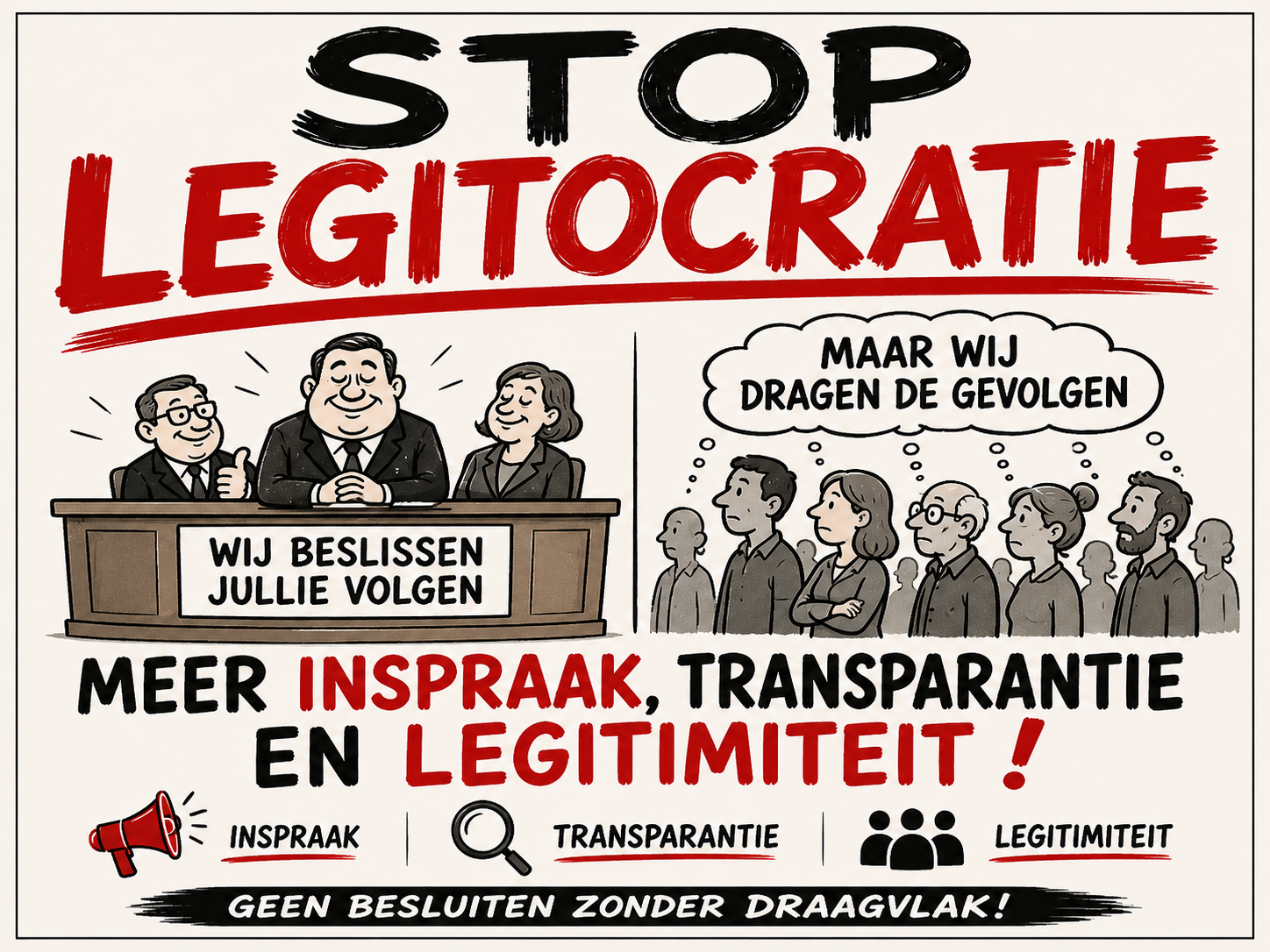
Legitocracy is a governance or organisational model in which legitimacy is not primarily created through genuine participation and transparency, but is deliberately constructed through procedures, information and communication, so that predetermined policy outcomes become socially acceptable without validation or meaningful resistance.
The BP case displays characteristics of legitocracy. Formal procedure, representation, communication and supervision were all present. Yet precisely when pensioners had to choose, this case file argues that the independent information, verifiable substantiation and genuine influence required for meaningful consent were missing.
Documents
These documents show which objections were formally submitted and which questions were put to the organisations involved. The original documents are in Dutch.
Samenvatting van het CWO BP Pensioenfonds-Zwitserleven dossier en inzet voor wetswijzigingRead the summary (PDF, Dutch) ↘Personal statement — Dutch PDFStatement on my involvement and activitiesOpen the original statement ↘This list is updated regularly.
BP Pensioenfonds case — complaint and follow-up
17 July 20261 — Formal complaint to BP PensioenfondsOpen Dutch PDF ↗26 August 20262 — Rejection of my complaint to BP PensioenfondsOpen Dutch PDF ↗26 August 20263 — My response to the DMC decisionOpen Dutch PDF ↗7 September 20264 — BP Pensioenfonds response to my replyOpen Dutch PDF ↗9 September 20265 — My final response concerning the handling of my complaintOpen Dutch PDF ↗2025 annual report6 — BP Pensioenfonds 2025 annual report, no auditor’s opinion is included.Open Dutch PDF ↗14 September 20267 — Comparison of ABP and BP Pensioenfonds: a legitimacy testOpen Dutch PDF ↗18 September 20268 — De cirkel is rondOpen Dutch PDF ↗4 October 20269 — The VOBP’s conduct during the pension transferOpen Dutch PDF ↗4 October 202610 — The BP Pensioenfonds’s conduct and the rejection of my complaintOpen Dutch PDF ↗13 October 202611 — GIP rejects complaintOpen Dutch PDF ↗DNB case — complaint and follow-up
8 July 20261 — Complaint to DNB’s Complaints CommitteeOpen Dutch PDF ↗26 August 20262 — Complaints Committee advice to DNB’s Executive BoardOpen Dutch PDF ↗27 August 20263 — My response to DNB’s Executive BoardOpen Dutch PDF ↗14 September 20264 — DNB’s deficient handling of my complaintOpen Dutch PDF ↗14 September 20265 — Explanation of the failure of DNB’s complaints handlingOpen Dutch PDF ↗4 October 20266 — DNB’s conduct and the rejection of my complaintOpen Dutch PDF ↗AFM case — request and follow-up
6 August 20261 — Request for an investigation by the AFMOpen Dutch PDF ↗8 September 20262 — Email to the AFM Complaints and Reports DepartmentOpen Dutch PDF ↗19 September 20263 — 2025 annual reports of BP Pensioenfonds and Beroepspensioenfonds Loodsen comparedOpen Dutch PDF ↗24 September 20264 — AFM rejectionOpen Dutch PDF ↗04 — The test
Distinguish legally enforceable guarantees from policy intentions and expectations. State who bears the risk if economic assumptions prove wrong.
Presence alone is not influence. Record which alternatives were proposed, assessed and rejected.
A formal position does not automatically equal demonstrable support. Publish consultations with the constituency and dissenting views.
A decision can only be scrutinised if rejected options, assessment criteria and sensitivity analyses are also visible.
Communication must be balanced: uncertainties, conflicts of interest and irreversible consequences must be as visible as the benefits.
Consent is meaningful only when all material information is available before the decision. Record what participants knew, what was missing and why the decision was not postponed.
Before consent, disclose the applicable pension and insurance terms, exact guarantees, indexation and cost rules, amendment provisions and remedies available in a dispute.
05 — Making decisions visible
Publish the problem definition, objectives and alternatives.
Make mandates, interests and minority views visible.
Compare rights, risks, costs and indexation.
Provide a traceable assessment that withstands supervision and challenge.
The principle
06 — From BP case to political proposals
The press release of 30 May 2026 translates the experience of the BP transfer into four proposals. They are not intended to reverse one decision, but to reduce the information and power imbalance in future pension buyouts through legislation.
Press release — 30 May 2026 — Dutch PDFRead the original press releaseRequire an actuarial and financial analysis that is available to participants and is neither paid for nor directed by a party with an interest in the transaction.
Response to: dependence on transaction dataPublish costs, risks, scenarios, guarantees, alternatives, governance and the balancing of interests in understandable form before participants must respond.
Response to: information without substantiationAllow pensioners to elect their representatives directly and give that representation demonstrable influence over major, irreversible pension changes.
Response to: mandate without accountabilityFor complex transfers, create a neutral information service unaffiliated with the pension fund, employer, adviser or insurer.
Response to: information from one interested chain“Pensioners deserve independent information and genuine representation in pension buyouts.”
07 — What you can do
Use this short checklist whenever the transfer is discussed:
Comments may be sent to pensioenoverdracht@pm.me
As a pensioner, I am personally involved in the collective value transfer from BP Pensioenfonds to Zwitserleven. During the process, I saw how difficult it was for individual participants to obtain a complete and independent picture of the consequences in time.
My questions concerned not only the financial outcome, but especially how the decision was made. Who represented pensioners? What mandate did they have? Which alternatives were examined? And why were participants asked to choose while important information and binding terms were still insufficiently visible?
When answers were absent or, in my view, insufficiently verifiable, I decided to assemble the available information and publish my findings. This website is the result.
I built this website myself, without help from a professional web developer or another organisation, but with the assistance of ChatGPT. It enabled me to organise my research, documents and arguments independently and make them accessible to a wider audience.
My purpose is not merely to draw attention to the situation at BP Pensioenfonds. Above all, I want to contribute to better protection, independent information and genuine representation for pensioners in future collective pension transfers.
John Michael Brummer,
The Hague, July 2026.